








What Does PSA 10 Mean? Gem Mint Grading Explained
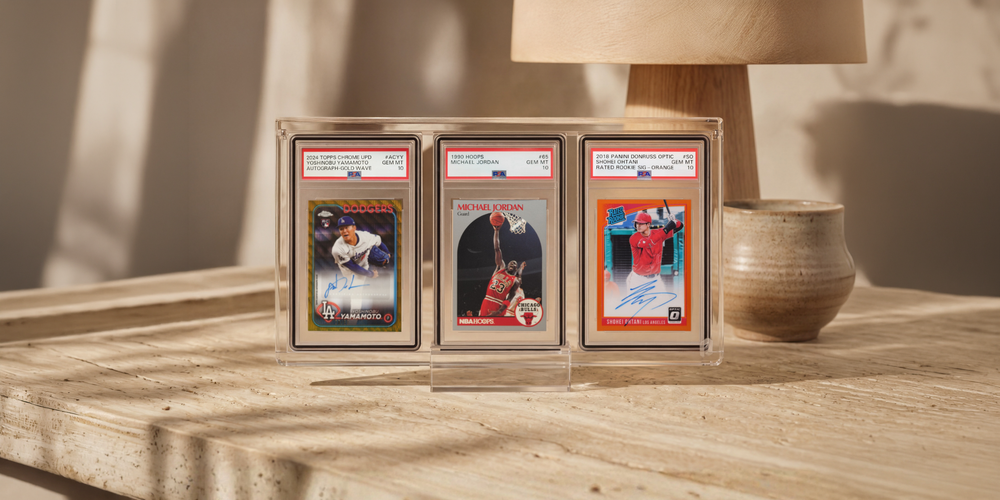
What Does PSA 10 Mean?
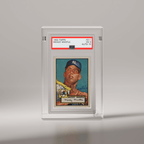
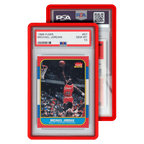
PSA 10 is the highest regular grade on PSA's 1-10 grading scale. The official designation is Gem Mint, and it represents a card in virtually flawless condition. When a card earns a PSA 10, it means PSA's professional graders examined it under magnification and determined it meets the strictest standards for centering, corners, edges, and surface quality.
PSA (Professional Sports Authenticator) is the most widely recognized grading authority in the hobby. A PSA 10 label tells buyers, sellers, and collectors one thing: this card is as close to perfect as a printed card can reasonably be.
If you are new to grading, our PSA grading guide for beginners covers the full process from submission to slab. This article focuses specifically on what that "10" means and why it matters.
What PSA Evaluates: The Four Grading Criteria
Every card submitted to PSA is examined across four categories. A PSA 10 must score exceptionally well in all four. One weak area can drop a card to a 9 or lower.
Centering
Centering refers to how evenly the card's image is positioned within its borders. PSA measures the ratio of border width on opposite sides. For a PSA 10, the front centering must fall within approximately 55/45, with a tolerance up to 60/40 on the front (left-to-right and top-to-bottom). The back centering is allowed slightly more tolerance at around 75/25. A card that looks "shifted" to one side will lose points here, even if everything else is perfect.
Corners
Graders inspect all four corners under magnification. At the PSA 10 level, corners must appear sharp and crisp with no visible wear, fraying, or rounding. Even a tiny amount of softness on a single corner can be enough to knock a card from a 10 to a 9.
Edges
The edges of the card must be clean and free of chipping, rough cuts, or visible wear. PSA graders look for any irregularities along all four edges. White specks along the border of a dark-edged card (sometimes called "edge whitening") are a common flaw that prevents a 10 grade.
Surface
Surface evaluation covers scratches, print defects, staining, and any other imperfections on the front or back of the card. This includes printing issues that originated at the factory. A PSA 10 card should have a clean, unblemished surface with no distracting marks visible under standard examination.
PSA 10 vs. PSA 9: Why One Point Changes Everything
On paper, the difference between a PSA 9 (Mint) and a PSA 10 (Gem Mint) is a single grade point. In practice, the gap in collector demand and market value is often enormous.
A PSA 10 consistently sells for multiples of what the same card grades at a 9. The exact premium varies widely depending on the card, the year, the print run, and how many PSA 10 copies exist. For some modern cards where PSA 10s are relatively common, the premium might be modest. For vintage cards or short-print releases where PSA 10s are scarce, the difference can be dramatic.
This premium exists because collectors and investors view PSA 10 as the definitive top tier. A PSA 9 is an excellent card. A PSA 10 is the card. That distinction drives buying behavior, and buying behavior drives prices.
The psychology is straightforward: when a collector is spending serious money on a single card, they want the best available grade. PSA 10 is the ceiling for the vast majority of cards, so it commands a premium that is disproportionate to the actual physical difference between a 9 and a 10.
"Gem Mint" vs. "Pristine" vs. "Perfect": Clearing Up the Confusion
If you have spent any time in grading discussions, you have probably seen terms like Pristine, Black Label, and Perfect 10 thrown around alongside Gem Mint. These are not the same thing, and the differences matter.
PSA 10: Gem Mint
PSA's highest regular grade. The card is virtually perfect under standard examination. This is the top of PSA's scale for standard submissions.
BGS 10: Pristine
Beckett Grading Services uses a different system. A BGS 10 is labeled Pristine and is considered rarer than a PSA 10 by many collectors. BGS also grades on four subcategories (centering, corners, edges, surface), each scored individually on the label. For a card to earn an overall BGS 10, all four subgrades must be 10s.
BGS 10 Black Label
When a BGS card receives a 10 in every subcategory, BGS issues a special "Black Label" designation with a distinctive black label on the slab. These are exceptionally rare and command significant premiums, often exceeding even PSA 10 prices for the same card.
The key takeaway: PSA 10 and BGS 10 are not equivalent grades. Many collectors consider BGS 10 Pristine a stricter standard, since it requires perfect 10s across all four subgrades. The two companies use different evaluation systems with different thresholds, so direct comparison is not straightforward. For a deeper look, see our BGS vs. PSA breakdown.
How Rare Is a PSA 10?
There is no single answer here because it depends entirely on the card. Three major factors determine PSA 10 rarity.
Modern vs. Vintage
Modern cards (printed in the last 10-15 years) tend to have much higher PSA 10 rates than vintage cards. Manufacturing quality control has improved significantly over the decades. A modern Pokemon or Prizm card from a recent set can see relatively high PSA 10 rates. A vintage card from the 1960s or 1970s might have a PSA 10 population in the single digits.
Print Quality and Manufacturer
Some sets are notorious for poor centering or surface issues straight from the pack. Japanese-printed Pokemon cards, for example, are often praised for higher quality control than their English counterparts. Certain manufacturers and print runs are simply more consistent than others.
Total Submissions
The number of PSA 10 copies that exist is directly tied to how many copies were submitted for grading. A card with 10,000 submissions and 6,000 PSA 10s tells a very different story than a card with 50 submissions and 2 PSA 10s. Raw population numbers alone do not tell you how rare a grade truly is. You need to consider the ratio.
The bottom line: for modern mass-produced sets, a PSA 10 is attainable but not guaranteed. For vintage, rare, or limited-release cards, a PSA 10 can be genuinely scarce and highly sought after.
Protecting Your PSA 10 After You Get One
Earning a PSA 10 is only half the equation. Keeping that card in Gem Mint condition over months and years takes deliberate care. The two biggest threats to a slabbed card are UV exposure and physical handling.
UV Exposure: The Silent Killer
Ultraviolet light degrades card surfaces over time. Holo patterns, chrome finishes, and vivid colors are especially vulnerable. A PSA 10 card displayed near a window or under direct lighting without UV protection will show fading over months and years. The damage is gradual and irreversible.
This is the top concern among serious collectors. In a recent survey we conducted, 78% of collectors cited UV and physical protection as their primary reason for investing in display cases.
If you collect Pokemon cards, our article on protecting Pokemon cards from UV damage dives deeper into this topic.
Physical Handling and Storage
Even though the PSA slab itself provides a layer of protection, repeated handling, stacking, and transport can cause micro-scratches on the case surface or, worse, cracks along the edges of the slab. A damaged slab reduces the perceived quality and resale value of your card, even if the card inside remains pristine.
The Case for a Proper Display Case
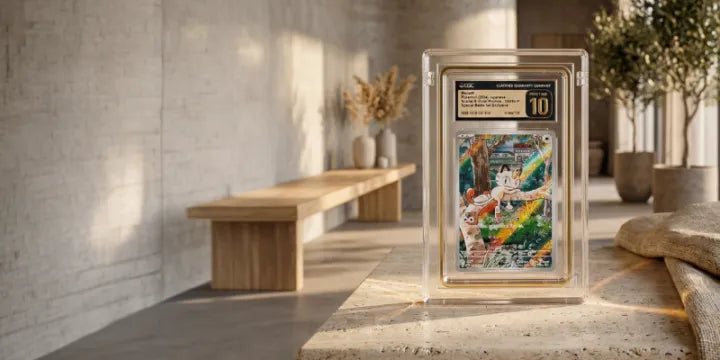
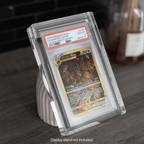
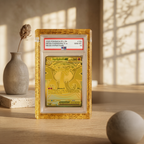
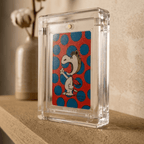
A dedicated acrylic display case addresses both threats at once. It provides a UV-resistant barrier between your slab and ambient light, while also preventing direct handling, dust accumulation, and accidental damage.
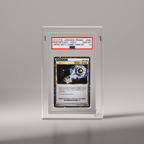
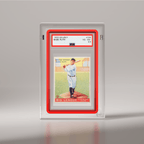
The Phantom Ultra is built specifically for this purpose: 10mm crystal acrylic per side, UV-resistant construction, and a neodymium magnetic seal that keeps the case securely closed without any tools or hardware. It is engineered for PSA slabs (as well as CGC, TAG, and SGC), with a dedicated PSA collection that ensures a precise fit for your graded cards.
If you have invested the time and money to get a PSA 10, the last thing you want is preventable damage degrading your card over time. Proper display protection is the final step in preserving what you have earned.
Quick Reference: PSA Grading Scale
| Grade | Label | Condition Summary |
|---|---|---|
| PSA 10 | Gem Mint | Virtually perfect in all four categories |
| PSA 9 | Mint | Excellent condition with only the most minor imperfections |
| PSA 8 | NM-MT | Near Mint to Mint, slight imperfections visible on close inspection |
| PSA 7 | Near Mint | Minor wear on corners or edges, slight surface issues |
| PSA 6 | EX-MT | Noticeable wear but still presentable |
| PSA 5 | Excellent | Moderate wear, some corner and edge deterioration |
| PSA 4 | VG-EX | Obvious wear across multiple areas |
| PSA 3 | Very Good | Significant wear, rounding of corners evident |
| PSA 2 | Good | Heavy wear, creasing may be present |
| PSA 1 | Poor | Extensive damage, card is complete but heavily worn |
The Bottom Line
PSA 10 Gem Mint is the gold standard in card grading. It means a card has passed rigorous examination across centering, corners, edges, and surface, and been judged virtually flawless. The grade carries significant weight in the market, often commanding multiples of what a PSA 9 of the same card sells for.
Whether you are evaluating a purchase, deciding what to submit for grading, or figuring out how to protect a PSA 10 you already own, understanding what that grade truly represents puts you in a stronger position as a collector.
Browse the full PSA display case collection to find the right fit for your graded cards.
Protect Your Graded Cards with UV-Resistant Acrylic
Your PSA 10 Gem Mint card deserves a display that matches its grade. Phantom Display cases use UV-protective crystal acrylic to preserve your highest-graded cards for years.
Shop PSA Display Cases