







Most Expensive Baseball Cards of All Time
Ask a room of collectors to name the most expensive baseball card of all time and you will hear the same answer: a 1952 Topps Mickey Mantle. In August 2022 that card sold for $12.6 million at Heritage Auctions, and as of July 2026 it still leads every baseball card ever sold at public auction. The Mantle does not stand alone, though. The very top of the baseball market is a short, concentrated list ruled by three names, Mickey Mantle, Honus Wagner and Babe Ruth, with two modern superstars now muscling in. For the wider cross-sport picture we keep a separate rundown that folds in basketball, football and hockey. This guide goes baseball-only, and deeper, because every price below is really a verdict on one thing: condition.
Two facts jump out the moment you line these sales up. First, the money is astonishingly concentrated: almost every seven-figure baseball card traces back to just three players. Second, the same card in different condition can swing by millions of dollars, which is why grading sits at the center of this entire market. Here are the baseball cards that have sold for the most, and the reasons collectors keep paying more.
Why do a few pieces of vintage cardboard change hands for millions of dollars? Three forces stack on top of each other. The first is nostalgia: the collectors bidding at this level grew up idolizing these players, and owning a rookie is owning a piece of that memory. The second is investment, since high-grade vintage cards have behaved like a serious asset class over the past decade and drawn in buyers who never opened a pack. The third, and the quietest, is supply. The greatest cards were printed in small numbers, survived in far smaller numbers, and can never be reprinted, so demand from a growing global collector base keeps running into a fixed and shrinking pool of high-grade copies. Stack those together and the ceiling only tends to rise.
Mickey Mantle: the 1952 Topps that still rules the hobby
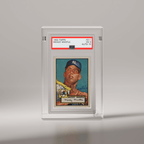
At number one is the 1952 Topps Mickey Mantle, card number 311. The specific example that set the record was graded a gem-mint 9.5, and Yahoo Sports reported it sold for a record $12.6 million at Heritage Auctions, a price that also made it the most valuable piece of sports memorabilia ever sold at the time. As of July 2026 no baseball card has topped it. What makes that number so instructive is the spread beneath it: a different 1952 Topps Mantle, several grade points lower, sold for $5.2 million in January 2021. Same player, same iconic card, same set. The gap of more than seven million dollars between the two examples is almost entirely a story of preservation, of centering and corners and surface, the qualities a grade captures and a lifetime of careless handling quietly destroys. The Mantle is the reason the hobby obsesses over condition, and the reason a card that survived roughly seventy years in near-perfect shape now trades like a blue-chip asset.
Honus Wagner: the T206 that started it all
If the Mantle is the king, the T206 Honus Wagner is the holy grail. Printed between 1909 and 1911 and distributed in tobacco packs, the Wagner is legendary for its scarcity; Sports Illustrated, citing the auction house Goldin, noted the card has fewer than 50 authenticated copies on earth. That rarity is why Wagner occupies two of the very top spots. The finest chapter came in August 2022, when a Wagner sold for $7.25 million in a private sale brokered by Goldin, ranking it the second most valuable baseball card ever as of July 2026. A different T206 Wagner had held the record only a year earlier, selling for $6.606 million in 2021, and a Wagner had already crossed seven figures as far back as 2016 at $3.12 million. No other pre-war card commands a ladder like this, because no other card pairs a first-ballot Hall of Famer with a printing quirk that cut the surviving supply to a relative handful and more than a century of unbroken demand.
Babe Ruth: the Bambino on cardboard
Babe Ruth sits third, and he gets there with his true rookie. The 1914 Baltimore News Ruth predates his fame, showing a nineteen-year-old George Herman Ruth as a pitcher for the minor-league Orioles rather than the slugger the world would come to know. Yahoo Sports reported that this copy, first collected from a Baltimore newspaper by a young paperboy, sold for $7.2 million at auction in December 2023, calling it the highest-selling Ruth item of all time and the second-highest price ever realized at auction for a trading card, per Robert Edward Auctions. Ruth appears again further down the list through his most beloved mainstream card, the 1933 Goudey: Sports Illustrated documented a 1933 Goudey Babe Ruth selling for $4.2 million in July 2021. As of July 2026 those two cards frame the Ruth market, one a near-mythical newspaper issue with a tiny surviving population, the other a colorful pre-war classic that collectors have chased for generations.
The modern outliers: Trout and Ohtani
Vintage cardboard dominates this list, but two current stars have forced their way into the rarefied air. Mike Trout got there first. In August 2020, Sports Illustrated reported that a one-of-one 2009 Bowman Chrome Draft Prospects Trout Superfractor, his signed rookie, sold for $3.936 million at Goldin, briefly the most expensive trading card of any kind. More recently, Shohei Ohtani has become the sport's first genuine modern challenger from the other side of the world: in July 2026 Fanatics Collect brokered a private sale of a one-of-one 2018 Bowman Chrome Ohtani Superfractor rookie for $3.365 million, a record for any Ohtani card as of July 2026. What unites these two with the vintage giants is not just fame but format, unique or nearly unique cards in the highest grades, where condition is not one detail among many but the entire proposition. Their arrival signals a shift: for the first time, modern and mass-produced cards can sit at the same table as pre-war treasures, provided they are genuinely one of a kind and flawlessly preserved.
What these prices really reward: condition and grading
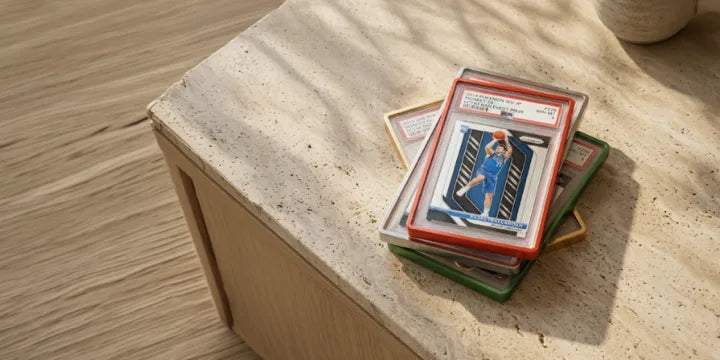
Look closely at every card above and the same pattern appears. The record-setters are graded, and they are graded high. A single point on the grading scale can separate a five-figure card from a seven-figure one, which is why the finest known copy of a legendary card behaves like a trophy asset. Grading does two jobs at once: it authenticates the card, and it certifies the exact condition the market is paying for. That is also the quiet lesson for every collector who owns cards well short of Mantle money. The reason these cards survived long enough to sell for millions is that, at some point, someone protected them from the things that wreck cardboard: ultraviolet light that fades ink and color, along with humidity, dust, fingerprints and the knocks of ordinary handling. Ultraviolet exposure is the slow, invisible one: it lifts color and yellows surfaces over years, and unlike a crease it can never be undone. Heat and moisture warp and stain. Even a few careless touches leave oils that quietly etch into a surface over time. A slab shields the card from a bump, but a slab left loose in a drawer is still fully exposed to light and neglect. If you display graded cards rather than hide them, our displays are built for exactly that job. Preservation is not a vintage-only problem; it is the same discipline whether a card is worth fifty dollars or five million.
Protect your high-value graded cards
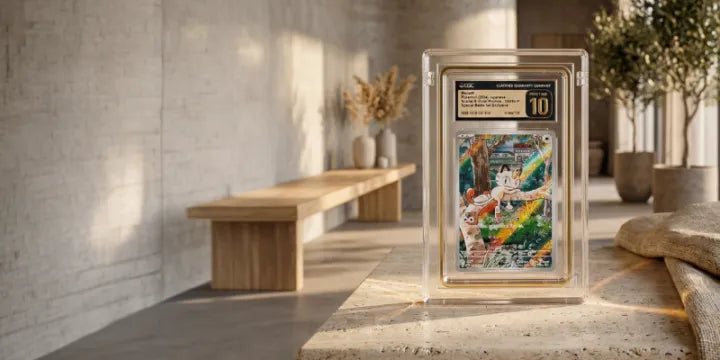
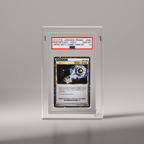
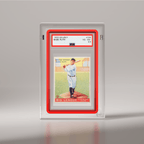
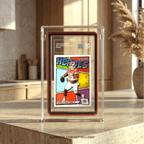
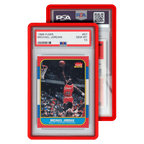
Cards like these are only worth what their condition says they are worth, which makes the way you store and show them part of the investment rather than an afterthought. Whether you own a vintage slab or a modern rookie, a proper display keeps ultraviolet light, dust and accidents away from the card while still letting you enjoy it every day.
Protect your graded investment
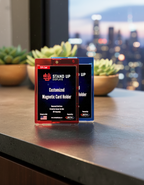
Graded cards are an investment, so display them like one. Our displays are sized per grading company, so the fit is precise for PSA, BGS, CGC, SGC and TAG slab dimensions rather than a loose compromise, and each full-size display pairs a neodymium magnetic closure with up to 99.6% UV protection on the acrylic. Rated 4.7/5 for quality by collectors.
Shop