



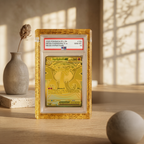
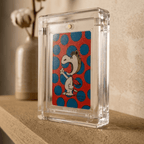
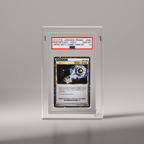
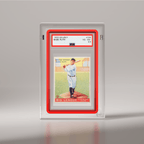





Best Graded Card Display Case: 2026 Buyer's Guide
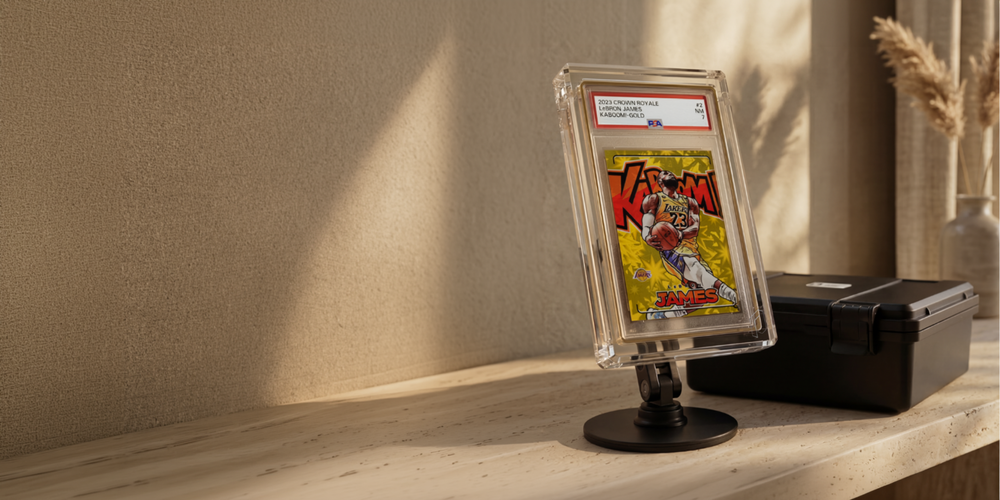
What Makes a Great Graded Card Display Case?
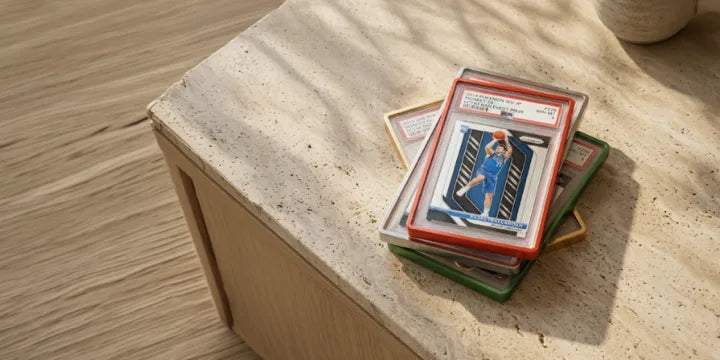
You spent weeks tracking down that PSA 10 Charizard. You paid for grading, waited months for the slab to come back, and now it sits on a shelf next to a stack of other cards. No protection from sunlight. No real presentation. Just sitting there.
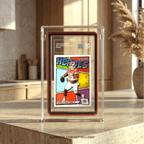
A display case should do two things: protect the card inside and make it look like it belongs in a collection worth showing off. That sounds simple, but most cases on the market fail at one or both. Thin acrylic yellows within a year. Generic sizing lets your slab rattle around. Hardware-based closures create pressure points that can crack over time.
This guide breaks down the four things that actually matter when choosing a graded card display case: UV protection, acrylic quality, closure mechanism, and fit. Whether you collect Pokemon, sports cards, or anything in between, these fundamentals apply.
UV Protection: The Single Most Important Feature
UV damage is the silent killer of card collections. It does not happen overnight. It happens over weeks and months of ambient light exposure, and by the time you notice, the damage is permanent.
Here is what UV light does to your cards:
- Holographic cards lose their shimmer. The metallic foil layer that creates the rainbow effect degrades under UV exposure. A holo Charizard that once caught light from every angle starts looking flat and washed out.
- Chrome and refractor finishes dull. Chrome cards rely on a reflective coating that UV radiation breaks down over time. The mirror-like finish gradually turns hazy.
- Vintage ink fades unevenly. Older cards printed with less UV-stable inks are especially vulnerable. Reds and yellows fade first, leaving cards with a ghostly, desaturated look that tanks both visual appeal and resale value.
- Card stock yellows at the edges. Even inside a graded slab, the white borders on vintage cards slowly yellow when exposed to UV, making the card look older and more worn than its grade suggests.
This is not a hypothetical risk. In a survey of graded card collectors, 78% cited UV and physical protection as their primary reason for buying a display case, and 61% specifically named UV protection against color fading as the single most important benefit they wanted.
If the display case you are considering does not explicitly address UV resistance, that is your first red flag. Budget cases marketed on Amazon and eBay rarely mention UV properties at all, because there is nothing to mention. Standard acrylic without UV-inhibiting additives offers minimal protection against the wavelengths that cause fading.
For a deeper look at UV damage specific to Pokemon cards, including before-and-after examples, see our guide: How to Protect Pokemon Cards from UV Damage.
Acrylic Quality: Thickness, Clarity, and Longevity
Not all acrylic is created equal. The display case market is flooded with thin, injection-molded cases that look fine on day one and start yellowing within months. Understanding acrylic quality comes down to three factors.
Thickness
Acrylic thickness is measured per side (each half of a two-piece case). Here is how to think about it:
- 10mm per side (premium tier): This is the standard for serious collectors. 10mm crystal acrylic offers superior optical clarity, meaningful UV resistance, and a substantial weight in hand that signals quality. It also resists scratching and surface damage better than thinner alternatives.
- 5mm per side (mid-tier): A solid option for collectors who want real protection without the extra weight or cost. 5mm acrylic still provides genuine UV resistance and clear optics, just in a slimmer profile.
- 1-3mm (budget tier): This is what you get from most generic cases on Amazon. At this thickness, acrylic provides almost no UV protection, scratches easily, and is prone to cracking at stress points. It also yellows significantly faster because thinner material has less inherent UV resistance.
Optical Clarity
High-grade acrylic is prized for its optical clarity, often exceeding glass in light transmission. This means your card looks as vivid through the case as it does with no case at all. Lower-grade acrylic introduces a subtle haze or greenish tint, especially noticeable on white-bordered cards or chrome finishes.
Yellowing Resistance
All acrylic will eventually yellow if exposed to enough UV radiation. The question is how long that takes. Premium crystal acrylic with UV-inhibiting properties can maintain clarity for years. Low-grade acrylic can start showing yellow tint surprisingly quickly under regular light exposure. If a display case manufacturer does not specify the grade of acrylic they use, assume it is the lowest quality option available.
Closure Mechanism: Why Magnetic Beats Everything Else
The way a display case opens and closes might seem like a minor detail. It is not. The closure mechanism affects three things collectors care about: card safety, ease of access, and visual design.
The Problem with Hardware-Based Closures
Traditional fastener-based cases use metal hardware at the corners to hold two pieces of acrylic together. This creates several issues:
- Pressure points. Over-tightening (which happens constantly) creates localized stress on the acrylic that can lead to hairline cracks over months. Under-tightening leaves gaps that allow dust inside.
- Metal contact. Fasteners pressing against acrylic create micro-abrasions every time you open and close the case. These scratches accumulate at the corners, exactly where your eye is drawn when the case is displayed.
- Slow access. Swapping cards in and out requires tools and patience. For collectors who rotate displays or bring cards to shows, this gets old fast.
- Visual clutter. Exposed hardware breaks the clean lines of the case. On a shelf of displayed cards, those metal fasteners at each corner become the most visible element.
Neodymium Magnetic Closure
Industrial-grade neodymium magnets embedded in the acrylic create an even seal across the entire perimeter of the case. No pressure points, no metal-on-acrylic contact, no tools required. The case opens with a firm pull and closes with a satisfying snap that tells you the seal is secure.
Magnetic closure also enables cleaner design. Without fastener holes or corner hardware, the case becomes a seamless piece of acrylic that practically disappears around your card. The focus stays on the card, which is the entire point.
Fit and Compatibility: Why "One Size Fits All" Is a Red Flag
This is the mistake most first-time display case buyers make. They assume a graded card is a graded card, so any case that holds a slab should work. It does not.
Grading companies use different slab dimensions:
- PSA slabs have specific length, width, and thickness measurements that differ from other graders
- BGS (Beckett) slabs are noticeably thicker and slightly different in overall footprint
- CGC slabs share similar dimensions to PSA but are not identical
- SGC and TAG slabs each have their own sizing as well
A case designed to hold a PSA slab snugly will let a BGS slab rattle. A case sized for BGS will leave a PSA slab swimming in extra space. In both scenarios, the slab shifts inside the case, which defeats the purpose of physical protection and looks wrong on display.
When you see a display case marketed as "universal" or "fits all graded cards," that means it is sized to accommodate the largest slab on the market. Every smaller slab gets a loose fit. Some sellers add foam inserts to compensate, but a foam shim is a band-aid for a fundamental design problem.
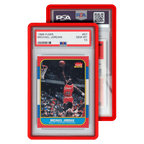
The better approach: cases engineered to the exact dimensions of each grading company's slab. You select your grader at checkout, and the case you receive is precision-sized for that specific slab. PSA collectors get a PSA-fit case. BGS collectors get a BGS-fit case. No rattling, no shimming, no compromise.
For a more detailed breakdown of PSA-specific display options, see our guide: PSA Slab Case 101.
Display Options: Desk, Shelf, or Wall
How you display your collection is a personal decision that depends on your space, your collection size, and how often you want to interact with your cards. There are three main approaches.
Free-Standing Display (Desk or Shelf)
The most common setup. A case with a built-in stand angle sits on a desk, shelf, or inside a detolf cabinet. This works well for smaller collections (under 20 cards on display) and gives you easy access to rotate cards in and out.
When evaluating a free-standing case, check the viewing angle. Some cases sit nearly flat, which forces you to look straight down. The best free-standing cases prop the card at a slight angle so it catches your eye from across the room.
Wall-Mounted Display
Wall mounting transforms a collection from "stuff on a shelf" into a gallery. Cards displayed on a wall become a focal point, visible the moment someone walks into the room.
The challenge with wall mounting has traditionally been hardware. Most solutions involve adhesive strips (which fail), nail holes (which damage walls), or bulky brackets that overwhelm the card.
The Magneto system solves this differently. Each Magneto case has a patent-pending embedded iron core, machined invisibly into the acrylic. A small wall mount with a 3M adhesive pad attaches to your wall, and the case connects magnetically. No drilling, no tools, no visible hardware. The card appears to float on the wall.
This system also works with the Magneto Desk Stand, which uses the same magnetic connection for a premium adjustable desktop display with 360-degree rotation.
Mixed Setup
Most serious collectors combine approaches. High-value grails go on the wall where they get maximum visibility. The rotating collection sits on desk stands. The deeper catalog stays in free-standing cases inside a display cabinet. The key is choosing a display system that supports all three without requiring completely different products for each.
Quick Comparison: Phantom Display Case Lines
Here is how the three main product lines compare at a glance:
| Feature | Ultra | Nano | Magneto |
|---|---|---|---|
| Acrylic Thickness (per side) | 10mm | 5mm | Crystal acrylic with embedded iron core |
| UV Resistance | Superior, museum-level | UV-resistant | Superior, museum-grade |
| Closure | Neodymium magnetic | Neodymium magnetic | Neodymium magnetic |
| Wall Mountable | No | No | Yes (magnetic mount system) |
| Desk Stand Compatible | Free-standing | Free-standing | Yes (magnetic desk stand) |
| Grader Compatibility | PSA, CGC, TAG, BGS, SGC | PSA, CGC, BGS, TAG | PSA, CGC, TAG, BGS |
| Style Options | Rounded, Prism, Color | Standard, Thick, Stand | Rounded, Prism, Color |
| Starting Price | $45 | $19 | $55 |
| Best For | Maximum protection, premium feel | Slim profile, larger collections | Wall display, flexible mounting |
All three lines use grader-specific sizing. When ordering, you select your grading company (PSA, BGS, CGC, etc.) to get a case engineered for that exact slab size.
Which Case Is Right for You?
The answer depends on three questions:
How valuable are the cards you are displaying?
For high-value grails (cards worth $500 or more), maximum protection matters. The Ultra with its 10mm crystal acrylic per side gives you the thickest shield against UV, impacts, and environmental damage. For a broader collection where you want to display 10 or more cards without a massive investment, the Nano at 5mm per side delivers genuine protection in a slimmer, lighter form factor.
Do you want to wall-mount?
If the answer is yes, or even "maybe someday," the Magneto is the only option that does not require aftermarket brackets or adhesive strips. The embedded iron core means you can start with desk display and move to wall mount whenever you are ready, with no new case required.
Do you use protective bumpers?
If you use GradedGuard bumpers or Slabmag holders on your slabs, standard cases will not fit properly. There are specific case variants sized to hold your slab with the bumper or holder attached. Trying to force a bumper-equipped slab into a standard case is a common mistake that leads to a poor fit and potential pressure on the slab.
The Bottom Line
A graded card display case is a long-term purchase. The case you choose today will sit on your shelf or wall for years, either protecting your cards or slowly letting them degrade. The difference between a good case and a mediocre one comes down to those four fundamentals: UV protection, acrylic quality, magnetic closure, and grader-specific fit.
Phantom Display cases are rated 4.7 out of 5 for both design and quality, and trusted by Fanatics Collect, eBay Live, Topps, and Heritage Auctions. Every case uses neodymium magnetic closure. Every case is engineered for specific grading companies. No universal sizing, no hardware fasteners, no compromises.
9 out of 10 collectors would recommend Phantom Display. See the full lineup:
- Phantom Ultra (10mm crystal acrylic, maximum protection)
- Phantom Nano (5mm acrylic, slim profile)
- Phantom Magneto (embedded iron core, magnetic wall mounting)
- All PSA Display Cases
- All Magneto Products
Protect Your Graded Cards with UV-Resistant Acrylic
Ready to upgrade your display? Phantom Display cases combine UV-protective crystal acrylic with neodymium magnetic closure for every major grading company.
Shop Graded Card Display Cases