










TAG Card Grading: The New Grader Explained
If you collect graded cards, you have probably started seeing TAG slabs turn up in auction listings and wondered what they are and whether it is worth sending your cards in. TAG, short for Technical Authentication & Grading, is one of the newer names in the grading market, and it takes a deliberately different route from the established players. This guide explains what TAG actually is, how its grading works, what the public record does and does not tell us about price and market acceptance, and who it suits. Where the record is thin, we say so rather than guess. That honesty is the point: most of what circulates about newer graders online is copied from unverifiable pages.
What TAG is and how its grading works
TAG describes itself as a technology-led grader. On its own site it states that since 2015, TAG has led the collectibles industry in multi-patented grading & authentication technology. That is TAG's own framing, so treat it as a company claim rather than neutral fact. It is corroborated in tone by independent collectibles outlet cllct, which, citing grading tracker GemRate, describes TAG, which touts its use of technology over manual grading by humans.
The core of TAG's method is imaging. TAG grades using what it calls Photometric Stereoscopic Imaging, and says that this system scores each card on a precise 1000 point scale that translates into the industry-standard 1 to 10 grade. Card identity, the name, year, set, card number and variations, is verified by OCR and a dedicated Card ID department. Every graded card includes a Digital Image & Grading report, which TAG shortens to DIG. The DIG report breaks a card's condition into five attributes: Corners, Edges, Centering, Surface and Dimensions, and its Card Vision viewer lets you zoom into a card up to 800x magnification to inspect defects. TAG also labels the specific flaws that drove a grade as DINGS, its term for Defects Identified of Notable Grade Significance.
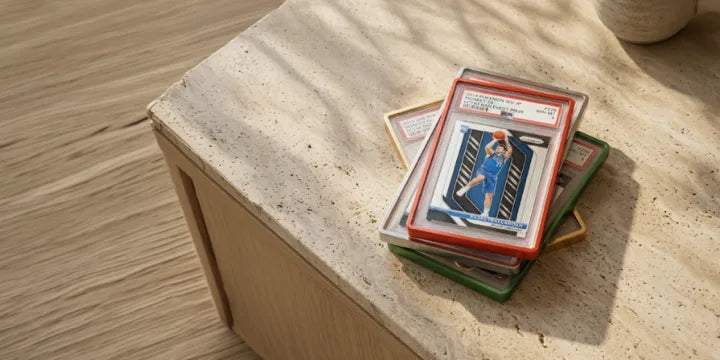
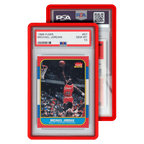
The slab itself is part of the pitch. TAG describes it as a transparent, paperless flip in which the grade and data are permanently inscribed directly inside the slab rather than printed on a paper insert. The encasing is made from UV- and abrasion-resistant acrylic that TAG states blocks most UV rays, with radiused edges for in-hand comfort and slabs that interlock and stack. Each slab carries PROOF security technology so a collector can use a smartphone to verify authenticity.
The TAG grade scale
TAG issues a familiar 1 through 10 grade, with a granular score underneath it. On its scale, TAG explains that grades run on a scale of 1 through 10, with half points included on every grade level except for between 9 and 10. The underlying 1000-point score maps to those grades: a 10 requires 990 to 1000 (which TAG calls Pristine) or 950 to 989 (Gem Mint), a 9 is 900 to 949, and it steps down to a 1 at 100 to 149. TAG's top designation, Pristine, exceeds the industry standard for a Gem Mint 10 and, by TAG's own account, represents less than 1% of the cards it grades.
Sitting alongside the grade is the TAG Score, the 3-digit, precise 100 to 1000 point score a card receives. It is meant to differentiate the strength of a grade, for example a low 10 from a high 10, and TAG uses it to rank cards on an official Leaderboard for each card. Per TAG, slabs graded with its DIG Report Plus service receive this precise 1000 point TAG Score. If you care about where a specific copy sits within its grade, that is the metric TAG is built around.
What it costs and how long it takes
TAG prices by the card's insured value, and here is its live pricing as of July 2026. Cards insured under $1,000 fall under TAG's Regular service, which has Basic, Standard and Express tiers. When we checked, all three Regular tiers were at capacity and taking waitlist sign-ups rather than orders, so no Regular price was bookable. Cards insured over $1,000 use TAG's Priority service, and that was bookable: the Priority tier at $149 per card and the Walkthrough tier at $299 per card. Turnaround is not published as a firm number, and TAG notes its estimated turnaround times are estimates and are not guaranteed, so confirm a live timeframe with TAG before you submit.
What is verifiable about eligibility is useful. As of July 2026, TAG lists on its currently grading page that it accepts standard-size cards up to 50pt stock thickness from the 1989-to-present era. So thicker patch or autograph slabs above that stock limit, oversized cards and most pre-1989 vintage fall outside what TAG grades. TAG also offers a separate encapsulation-without-a-grade service it calls TAG Verified Authentic for cards you want sealed but not graded.
How TAG compares to PSA, BGS and CGC
On market acceptance, the honest answer is that TAG is a real but small newcomer, and the resale side is not well documented by any neutral source. The volume picture is clear. According to GemRate data reported by cllct, in 2025 PSA graded 19.26 million cards, SGC graded 1.42 million, Beckett graded more than 824,000, and TAG graded more than 440,000. PSA alone captured 72% of the overall market that year. TAG's 440,000-plus was up 83% year over year and an all-time single-year record for the company,. In other words, TAG is growing fast, but it still rounds to a low-single-digit share of a market PSA dominates, with Beckett (BGS) and CGC far more established than TAG by track record.
What about resale value? No authoritative or neutral source publishes a reliable TAG-versus-PSA price gap, so we are not going to assert one. The only figures in circulation come from low-authority marketplace and tool pages. For what it is worth, and strictly as that outlet's own attributed estimate, one graded-card marketplace argues though no neutral source publishes a reliable figure, so treat any specific number as opinion, not verified market data. The defensible, non-fabricated takeaway is simply that PSA's scale and buyer recognition give it the deepest liquidity today, as our comparison explains, and any newer grader, TAG included, carries less established resale history.
Outside its own marketing, TAG has started to win real industry backing. In December 2025 the major consignment marketplace COMC announced it was adding TAG, saying COMC is thrilled to announce a new partnership with TAG, bringing TAG's cutting-edge, technology-driven grading solutions directly to the COMC platform. COMC framed the appeal in the same terms TAG does, noting its patented computer-vision and imaging technology delivers data-backed results using a precise 1000-point scale, ideal for collectors seeking detailed, reliable assessments. That is a marketplace, not a neutral referee, so read it as a commercial endorsement rather than proof of resale value, but a platform of COMC's size choosing to carry TAG slabs is a meaningful signal that the grader is being taken seriously.
Who should and should not use TAG
TAG makes sense if you value data and imaging over a purely human eye, and you want the granular DIG report, the 800x Card Vision viewer, the DINGS defect breakdown and the 1000-point TAG Score with its per-card leaderboard. The transparent, inscribed slab is a genuinely different aesthetic, and if your submissions are standard-size modern cards from 1989 onward within the 50pt limit, they fit TAG's remit. TAG is less suitable if your priority is the widest possible buyer recognition and resale liquidity right now, where PSA's scale is hard to beat, or if you are grading pre-1989 vintage or thick and oversized cards that sit outside TAG's stated eligibility. As always, confirm current pricing and turnaround with TAG before committing.
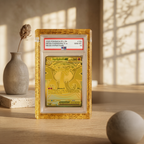
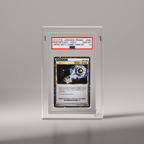
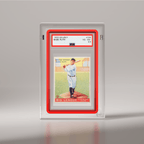
Whichever grader you choose, the slab that comes back deserves better than a desk drawer. A graded card is an investment in condition, and TAG's own encasing blocks most UV rays rather than all of it, so a proper display adds a real layer of protection and presentation. Our displays are sized per grading company, so the fit is precise for TAG, PSA, BGS, CGC and SGC slab dimensions rather than a loose compromise, and each uses a neodymium magnetic closure with up to 99.6% UV protection on the full-size acrylic. Grade the card, then show it the way it deserves.