





How to Store Pokemon Cards for the Long Term
Storing Pokemon cards well is not about finding a drawer to shove them in. Cards degrade from four things: light, heat, humidity and pressure, and every one of them is working on your collection the moment you stop playing with a card. This guide covers the whole spectrum, from a shoebox of bulk commons to a graded Charizard you will still want crisp in ten years, so you can match the storage to what the card is actually worth.
What actually damages a stored card
Four forces do the damage. UV light fades ink and yellows card stock, which is why a card left near a window loses colour long before one kept in the dark. Heat and humidity are the quiet killers: warm, damp air warps cards, lifts surfaces and invites the tiny spots collectors call foxing. Physical pressure from stacking or an overfilled binder puts permanent dents and bends into corners and edges, the exact areas a grader scrutinises. And handling transfers oils and moisture from your fingers straight onto the surface. Good storage is really just removing those four threats, in rough order of how much the card is worth.
Bulk and playable cards
For commons, duplicates and deck cards, the goal is tidy and safe, not fortified. Penny sleeves are the baseline: they keep surfaces apart so cards do not scuff each other. From there, a binder with side-loading pages is the friendliest way to store and browse a set, because top-loading pockets let cards slide out and catch edges. One rule matters more than any product here: avoid anything made with PVC. Older soft plastics can leach and cloud a card over years. Look for acid-free, PVC-free pages and boxes, and store them upright like books rather than in a tall flat stack that crushes the cards at the bottom. Our protectors cover the sleeves and holders this everyday tier needs.
Valuable raw cards you have not graded
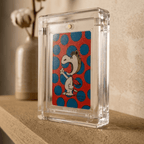
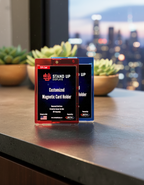
Once a raw card is worth real money, step the protection up. The standard is to double-sleeve: a snug perfect-fit inner sleeve, then a penny sleeve over it, so the card is never touched directly and cannot slip. House that in a rigid toploader or a magnetic one-touch holder, which stops bending entirely. Store these upright in a cool, dark box rather than loose in a drawer, and keep them out of any spot that swings between hot and cold. This is also the state you want a card in before you send it to a grader, since a bent corner or a surface scratch picked up in storage is exactly what drags a grade down.
Graded slabs
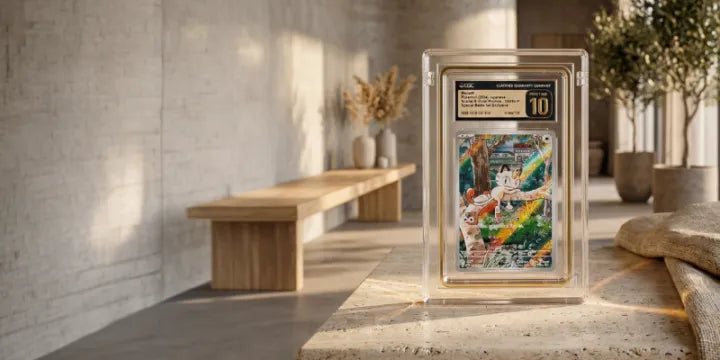
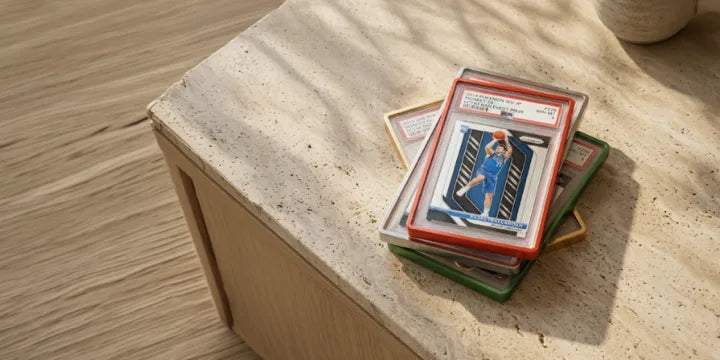
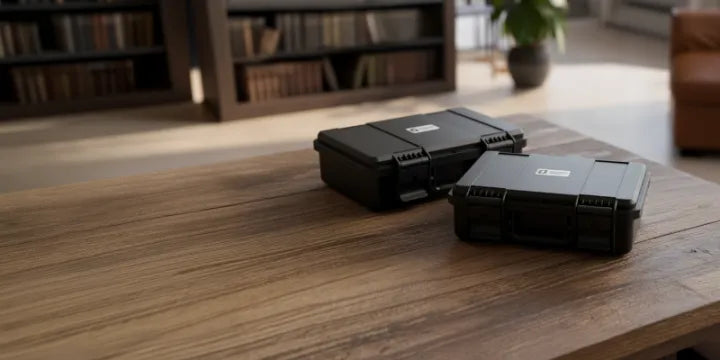
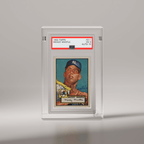
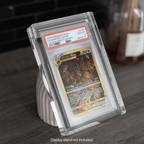
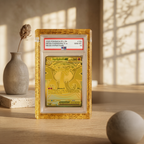
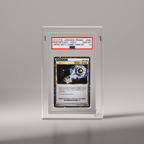
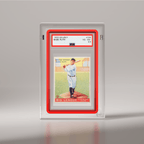
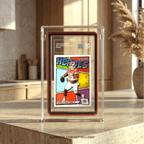
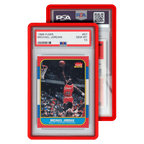
A slab already solves the physical problem: the hard case guards the corners and edges, and you should never crack one open to store the card differently. What a slab does not fully solve is light and heat, so a wall of graded cards baking in direct sun will still fade over years. Keep slabs out of direct sunlight, store them upright in a dedicated slab box if they are in the vault, and put the ones you actually want to enjoy into a proper display. That is the one case where storage and showing off are the same decision, and our displays are built for exactly that.
The environment matters more than the product
You can buy the best sleeves in the world and still lose cards to a bad room. Aim for cool, dark and dry, with a stable temperature rather than a cellar that sweats in summer and an attic that bakes. Avoid basements and attics for anything valuable, keep cards away from exterior windows, and if your climate is humid, drop a few silica gel packs into the box and replace them when they saturate. Store everything upright and never under heavy weight. Stability is the real goal: cards handle a steady room far better than one that keeps changing on them.
A quick storage checklist
Sleeve every card you care about, double-sleeve the valuable ones, and put raw high-value cards in a toploader or one-touch. Keep everything out of direct light, in a cool and dry room with a steady temperature, and store cards upright rather than stacked flat under pressure. Use PVC-free, acid-free supplies, and give graded slabs either a slab box or a display rather than a sunny shelf. None of it is expensive or difficult, and it is the difference between a collection that holds up and one that quietly loses grade while it sits.
For the cards that have earned it, a display does double duty: it takes the slab out of the dark and protects it at the same time. Our displays are sized per grading company, so the fit is precise for PSA, BGS, CGC, SGC and TAG slab dimensions rather than a loose compromise, and each full-size display uses a neodymium magnetic closure with up to 99.6% UV protection on the acrylic. Store the collection properly, then give the best of it a home worth showing.