









BGS vs PSA: Which Grading Company Should You Choose in 2026?
The BGS vs PSA debate has been raging for over a decade, and 2026 has thrown a curveball that changes the conversation entirely: PSA's parent company, Collectors, acquired Beckett in late 2025.
That's right, the two biggest card grading rivals are now under the same corporate roof.
Does this change which company you should grade with? It depends. Let's break down everything, the grading scales, the pricing, the resale premiums, and what that acquisition actually means for your cards.
The Quick Answer
If you don't want to read 2,000 words:
- Grade with PSA if you want maximum resale value and liquidity for most cards
- Grade with BGS if you want detailed subgrades and are chasing the Black Label premium
- Consider CGC or SGC if you want the best value or fastest turnaround
Now here's why.
Grading Scale Comparison
This is the fundamental difference between the two companies, and it matters more than most people realize.
PSA: Clean and Simple (1-10)
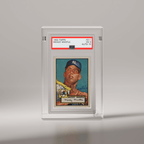
PSA gives you one number. No subgrades, no breakdowns. Your card is either a 10 (Gem Mint), a 9 (Mint), an 8, or whatever it scores.
The good: Simple, universally understood, easy to price and sell.
The bad: A "strong" PSA 10 and a "weak" PSA 10 get the exact same label. You can't tell from the grade alone whether the card barely squeaked in or was absolutely flawless.
Key grades: - PSA 10 (Gem Mint): The goal. Commands the highest premiums - PSA 9 (Mint): Still excellent. Typically 50-70% less valuable than a 10 - PSA 8 (NM-MT): Good card with minor wear visible on close inspection
BGS: Subgrades Tell the Story
BGS breaks your card's grade into four subgrades: - Centering, How well-centered is the print? - Corners, Are they sharp? - Edges, Clean or dinged? - Surface, Scratches, print lines, defects?
Each subgrade is scored independently, and your overall grade is calculated from all four. This gives you a much more detailed picture of the card's condition.
Key grades: - BGS 10 Black Label (Pristine): All four subgrades are a perfect 10. Extremely rare, maybe 1-3% of BGS 10s earn this. Can sell for MORE than PSA 10s - BGS 10 (Gem Mint): Overall 10, but subgrades can include 9.5s - BGS 9.5 (Gem Mint): The "realistic" top grade for most cards. Very strong - BGS 9 (Mint): Still excellent with slight imperfections
The Black Label Factor
Here's where BGS has a genuine edge over PSA. A BGS 10 Black Label, all four subgrades at 10, is the highest achievable grade in the hobby. Period. There's no PSA equivalent.
For certain modern cards (especially chrome/Prizm products), a Black Label can command a significant premium over a PSA 10. The rarity is real, they're extraordinarily difficult to get.
The catch: You can't aim for a Black Label. You submit a perfect-looking card and hope. Many collectors have sent dozens of pristine-looking cards to BGS and gotten zero Black Labels. Your eyes aren't as good as you think they are.
Pricing Comparison (2026)
Pricing has shifted significantly with the acquisition, and again in mid-2026. Here's the current landscape:
PSA Pricing (as of July 2026)
| Service Level | Cost and Max Insured Value | Turnaround |
|---|---|---|
| Regular | $79.99 per card, insured to $1,500 (as of July 2026) | 40-50 business days |
| Express | $149 per card, insured to $2,500 (as of July 2026) | 20-30 business days |
| Super Express | $349 per card, insured to $5,000 (as of July 2026) | 7-10 business days |
| Walk-Through | $599 per card, insured to $10,000 (as of July 2026) | 5-7 business days |
One important mid-2026 change: PSA is temporarily pausing its cheaper Value service tiers, citing extraordinary demand, so the schedule above is what you can actually book right now. For the full PSA pricing breakdown, see our PSA cost guide.
BGS Pricing (as of May 2026)
| Service Level | Cost | Turnaround |
|---|---|---|
| Base | $14.95 without subgrades, $17.95 with subgrades (as of May 2026) | 75+ business days |
| Standard | $34.95 (as of May 2026) | 45 business days |
| Express | $79.95 (as of May 2026) | 15 business days |
| Priority | $124.95 (as of May 2026) | 5 business days |
Key BGS advantages over PSA pricing: - No minimum card requirement or maximum submission cap at any level - No minimum or maximum card value for any tier - No membership program required, while PSA gates its cheapest bulk pricing behind its Collectors Club program and has paused those Value tiers outright - No value upcharges, BGS won't bump your fee if the card grades higher than expected (PSA will); the only listed extra is $3 for subgrades on Base-tier 10s (as of May 2026) - Subgrades included or available at all tiers
Budget winner: BGS. Their Base tier at $14.95 per card (as of May 2026) with no membership and no minimums undercuts PSA's cheapest bookable service, Regular at $79.99 per card (as of July 2026), by a wide margin now that PSA's Value tiers are paused. And BGS won't upcharge you on value.
Turnaround winner: SGC (not BGS or PSA). SGC's expedited service is quoted at 2 to 3 business days, from $150 per card (as of July 2026), the fastest advertised turnaround among the major graders.
Resale Value: Where PSA Still Wins
This is the number that matters most for sellers:
PSA 10s consistently command higher resale prices than equivalent BGS 9.5s across most card categories. This premium is especially pronounced for: - Vintage cards (pre-1980) - Flagship rookie cards - Pokémon and TCG cards
PSA captured 72% of the overall market share in 2025, including 76% of sports cards and 69% of TCG, according to GemRate data reported by Yahoo Sports. This creates a self-reinforcing cycle, collectors prefer PSA because it's the standard, which increases liquidity, which attracts more submissions.
When BGS Commands a Premium
- Black Labels: A BGS 10 Black Label can significantly exceed a PSA 10 in value
- Modern chrome products: BGS has a strong reputation for Prizm, Select, and chrome cards
- Subgrade appeal: Some collectors specifically prefer BGS for the subgrade transparency, they want to know the centering is a 10, not guess
How Grading Multiplies Raw Card Values
Professional grading typically multiplies raw card values substantially, but the premium varies by service and grade level. PSA graded cards generally maintain more consistent premiums across different condition levels, a PSA 8 typically holds stronger value relative to raw condition compared to lower BGS numerical grades, reflecting PSA's broader market acceptance among casual collectors and investors.
BGS premiums concentrate heavily at the top end. High-grade BGS cards with strong subgrades and Black Label perfect scores can command substantial premiums over equivalent PSA grades, but lower BGS grades often lag behind comparable PSA cards in resale value.
The authentication premium alone, proving a card is genuine, adds significant value over raw cards, even before considering condition premiums. Both services provide this authentication value, but PSA's wider recognition makes their authentication more universally accepted by buyers.
Protect Your Graded Investment
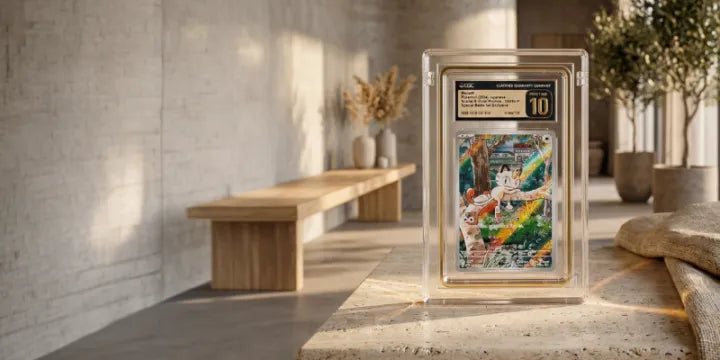
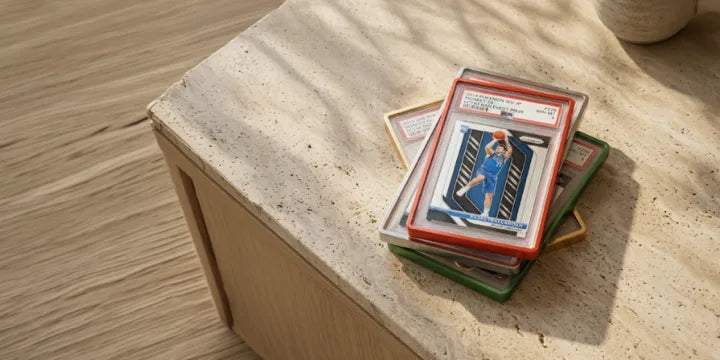
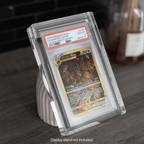
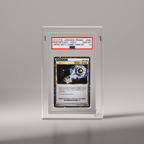
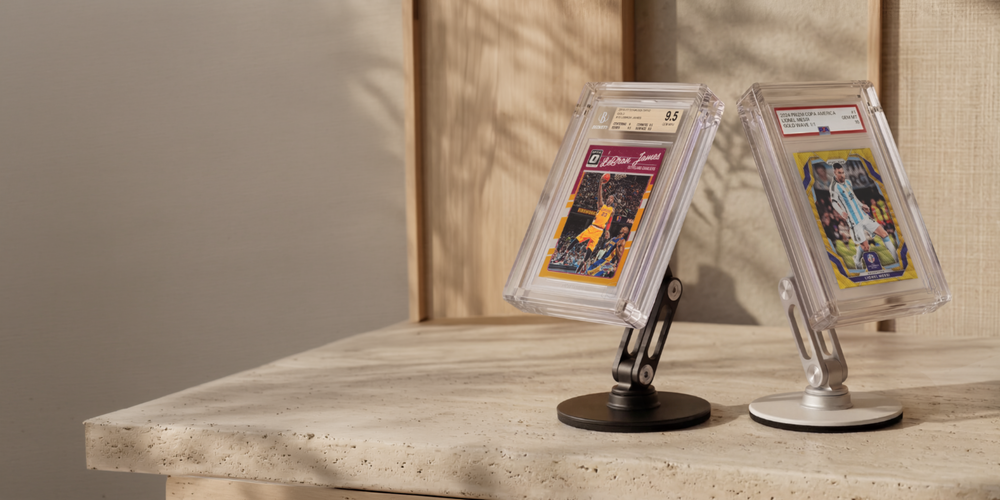
Whether you grade with PSA or BGS, UV light and handling damage degrade unprotected slabs over time. Phantom Display cases are engineered with premium acrylic and neodymium magnetic closure, designed for PSA, BGS, CGC, and SGC slabs. Rated 4.7/5 for quality by collectors.
ShopGoing with Beckett? See our BGS slab displays, sized for the thicker BGS holder. Collecting CGC? See our CGC slab displays, cut for CGC dimensions.
The Math
Say your card is one where a BGS 9.5 typically brings less than a PSA 10, which is the pattern for most modern cards.
- PSA grading cost: from $79.99 per card (as of July 2026)
- BGS grading cost: from $14.95 per card (as of May 2026)
Even with BGS's far lower grading fee, the PSA 10's higher resale often nets you more on a sale. But if you're building a personal collection and don't plan to sell? BGS's lower pricing and subgrades make a strong argument.
Card-Type Value Breakdown: Where Each Service Wins
The right grading service depends heavily on what kind of cards you're submitting. Here's how BGS and PSA stack up across the major card categories.
Pokémon and TCG Cards
PSA is the clear winner for most Pokémon cards across all eras, from Base Set through current releases. The Pokémon collecting community has embraced PSA's straightforward grading approach, and PSA 10s consistently command higher premiums than equivalent BGS top scores for most modern Pokémon singles.
BGS only makes sense for modern Pokémon when targeting ultra-premium cards likely to achieve Black Labels. Cards with exceptional centering and flawless surfaces might justify BGS's Standard tier at $34.95 per card (as of May 2026), but most modern Pokémon perform better financially through PSA grading.
For Pokémon investors, PSA's population reports provide better market transparency and pricing guidance. PSA's larger submission volumes create more comprehensive data for making investment decisions about modern Pokémon cards. Once graded, protect them with a dedicated Pokémon card display.
Vintage Sports Cards
Vintage sports cards present the most complex grading decision since both services offer distinct advantages depending on card value and target market. High-value vintage often benefits from BGS's detailed subgrade analysis that helps justify premium prices to serious collectors.
BGS Base tier pricing at $14.95 per card (as of May 2026) offers significant cost savings for vintage cards where you're primarily seeking authentication rather than maximum resale premiums. The extended turnaround of 75+ business days typically doesn't impact vintage card values since these aren't time-sensitive investments.
High-value vintage cards in exceptional condition should consider BGS grading when targeting serious collectors who scrutinize every aspect of card condition before making significant purchases. For mid-tier vintage targeting broader collector markets, PSA's universal recognition drives more consistent demand.
Modern Sports Cards
Ultra-modern sports cards favor PSA grading due to the service's popularity among younger collectors and social media influence. PSA's red label has become synonymous with premium modern cards in online marketplaces and collector communities.
The exception is modern chrome and Prizm products, where BGS has built a strong reputation. If you're submitting Prizm, Select, or other chromium cards and believe they have a shot at a Black Label, BGS is worth considering for the potential premium.
BGS Black Label vs PSA 10: The Value Gap Explained
BGS Black Labels represent the absolute pinnacle of card grading, cards receiving perfect 10s for all four subgrades achieve this coveted designation. These cards typically command meaningful premiums over PSA 10s of the same card, though the premium varies by card type and market conditions.
The scarcity of Black Labels drives their premium pricing. While PSA 10s appear regularly for most modern cards, Black Labels occur infrequently in BGS submissions, creating natural scarcity that collectors value highly.
Vintage Black Label Premiums
Vintage cards show the most dramatic Black Label premiums. Premium vintage cards in BGS Black Label condition consistently sell for more than comparable PSA 10 examples, reflecting the ultra-premium market's preference for verified perfect subgrades on iconic cards.
Modern Black Label Premiums
Modern cards show smaller but still meaningful Black Label premiums. Even relatively common modern Pokémon cards can see notable price differences in Black Label condition compared to PSA 10s, though the absolute dollar difference may not always justify the additional grading risk and cost.
How Turnaround Times Impact Your Investment Strategy
Turnaround times directly impact investment returns by affecting when you can realize gains from card appreciation. Market timing can significantly influence final sale prices, making service speed a crucial factor in grading decisions.
PSA's longer turnaround times at budget tiers work best for long-term investment strategies where immediate liquidity isn't necessary. Extended processing means your cards remain unavailable for months, which could impact selling opportunities during market peaks.
BGS offers more predictable timelines, with Base tier at 75+ business days. This consistency helps with portfolio planning and timing market entry points more effectively than variable processing schedules.
Express services from both companies sacrifice cost efficiency for speed. BGS Priority at $124.95 (as of May 2026) provides 5-day turnaround but dramatically impacts ROI calculations for most card values. Only high-value cards justify express pricing when market timing matters significantly.
Hidden Costs That Affect Your ROI
Beyond base grading fees, several costs significantly impact your total investment in graded cards:
- Subgrade fees: BGS lists a $3 addition for subgrades on Base-tier submissions (as of May 2026), which can accumulate quickly on large submissions
- Shipping and insurance: Costs vary between services but typically add meaningful amounts per batch. BGS's faster turnaround times at upper tiers can reduce insurance periods, while PSA's longer processing increases insurance exposure for high-value submissions
- Minimum submission quantities: Bulk tiers, when offered, carry minimum-quantity requirements that can force suboptimal timing decisions, you might submit borderline cards to meet minimums rather than waiting for better candidates
- Opportunity costs: Cards tied up in grading can't capitalize on market spikes. This often exceeds visible fees in missed gains, especially for trending card categories where timing matters most
- PSA upcharges: If your card grades higher than expected and its market value exceeds the tier's declared value limit, PSA will bump your fee. BGS never does this
Factor all of these into your service selection, the cheapest per-card grading fee doesn't always produce the best return.
The Acquisition: What It Means for You
In December 2025, PSA's parent company Collectors announced it would acquire Beckett. Here's the bigger picture: Collectors already owned PSA and SGC. That means three of the four major grading companies (PSA, BGS, and SGC) are now under the same corporate roof. Only CGC remains independently owned. Following its acquisitions of SGC and Beckett, Collectors and its brands held roughly an 80% market share in 2025, per GemRate.
This was significant enough that a New York congressman called for an investigation into a potential monopoly on trading card grading in January 2026.
What We Know
- BGS claims to be operating independently with its own grading standards
- Grading standards haven't visibly changed (yet)
- Some collectors are moving away from Collectors brands to support genuine competition, which now means CGC is the only fully independent major grading company
What to Watch
- Will BGS and SGC grading standards converge with PSA's over time?
- Will there be a combined submission platform or cross-grading between the three?
- How will the monopoly investigation play out?
- Will CGC's market share grow as the only independent option?
Our take: In the short term, nothing changes for your cards. Grade with whichever company makes sense. Long term? CGC is worth watching closely as the only major independent grading company. Competition is healthy for the hobby, and right now there's a lot less of it than there was a year ago.
When to Choose PSA
✅ You plan to sell the card, PSA 10s are the most liquid grade in the hobby ✅ You're grading vintage cards, PSA dominates the vintage sports card market ✅ You want universal recognition, every buyer knows PSA ✅ You're grading Pokémon/TCG, PSA is the default for the Pokémon market ✅ Maximum resale value is the priority
When to Choose BGS
✅ You want subgrades, transparency into exactly why your card received its score ✅ You're chasing Black Labels, the highest achievable grade in the hobby ✅ You're grading modern chrome/Prizm, BGS has strong recognition for these products ✅ Budget matters, BGS pricing undercuts PSA significantly ✅ You're building a personal collection, subgrades add value for collectors who appreciate detail
When to Choose Neither
Sometimes the answer is CGC or SGC:
- CGC is gaining ground fast, especially for Pokémon/TCG. Their dual-10 system (Pristine 10 vs Gem Mint 10) makes a lot of sense, and crucially, CGC is now the only fully independent major grading company following Collectors' acquisition of Beckett (which already owns PSA and SGC). The full CGC picture is in the section below.
- SGC has the fastest advertised turnaround among the majors on its expedited tier and a loyal following for vintage cards. Their "tuxedo" slabs have a distinctive black border that looks sharp. Note: SGC is owned by Collectors (same parent as PSA and now BGS).
For a deeper comparison of all four companies, check our comprehensive grading comparison guides.
CGC vs PSA: Grading, Fees and the Holder
CGC deserves more than a footnote in this comparison. GemRate counted 26.6 million cards graded across the hobby in 2025, as reported by Yahoo Sports, and CGC finished second among the major graders with 4.92 million of them. Its 121% year-over-year growth was the largest of any major grader, driven mostly by Pokémon and TCG submissions.
The TCG numbers are the reason to take it seriously. CGC captured 25% of the TCG market in 2025, second behind only PSA, and its slabs are now a normal sight in high-end TCG sales. For sports cards, and especially vintage, PSA and BGS still dominate both volume and buyer preference.
CGC Cards runs two tiers of perfection at the top of its 10-point scale. A Gem Mint 10 is the standard top grade. Above it sits the Pristine 10 label, which CGC reserves for cards that are "flawless under 10-times magnification" and which carries its own label design.
Fees are where the two split hardest. CGC's published card tiers start at Bulk, $17 per card with a 25-card minimum, a $500 maximum value and a 150 working day estimate. Economy is $20 per card up to $1,000 in 90 working days, Standard is $55 up to $3,000 in 10 working days, and Express is $100 up to $10,000 in 5 working days. PSA moved the other way. In its February 2026 pricing update, new card submissions went to $32.99 for Value, up from $27.99, $49.99 for Value Plus, $64.99 for Value Max and $79.99 for Regular, and Regular's estimate went from 20 to 25 business days. PSA also folded TCG Bulk and Value Bulk into one Collectors Club-only Value Bulk service at $24.99.
Line those up and the entry cost is the story. On PSA's February 2026 numbers, CGC Economy at $20 sits $12.99 under PSA Value at $32.99, and PSA's cheapest card tier now sits behind a Collectors Club membership while CGC's cheapest sits behind a 25-card minimum. CGC also takes 10% off grading for Associate and Premium members and 20% for Elite members. Both reprice, so check the current tables before submitting.
The holder differs too. CGC seals cards in an ultrasonically welded, crystal-clear holder, and the label carries microprinting, UV ink, holographic foil, a certification number and a QR code that pulls up the card's images on CGC's site. Read that UV ink correctly: it is a security feature printed on the label, not a UV filtering claim for the holder.
The trade-off is market depth: with PSA grading far more cards than anyone else, PSA slabs tend to trade in deeper, more liquid markets, so check recent sold comps for your specific card before choosing. Where CGC is strongest is modern TCG, non-sports sets and higher-volume submissions, and it carries a structural point in its favor: it is the only major grader left outside the Collectors group.
For resale, the grading fee is the floor. A card has to gain more than it costs to grade before submitting makes sense, so a $12.99 per card gap moves which raw cards clear the bar, and the cert number and QR lookup are what a buyer checks before paying.
Once the slab is back, it still needs protecting on the shelf. Phantom cuts its displays to CGC holder dimensions, with up to 99.6% UV protection on every model except Nano. See the CGC slab displays.
Protecting Your Graded Cards
Regardless of which company you choose, your slabs need proper protection, especially for display. Neither PSA nor BGS slabs offer UV protection, and UV damage causes irreversible fading over time.
Phantom's acrylic displays offer up to 99.6% UV protection and are sized for PSA, BGS, CGC, and SGC slabs. Whether you're Team PSA or Team BGS, your cards deserve museum-grade protection.
For your highest-value graded cards, the Magneto offers museum-grade protection with magnetic mounting that celebrates your premium slabs without risking damage from handling. And GradedGuard cases provide tamper-evident security and crystal-clear visibility for your most prized submissions. For free-standing display, the Phantom Ultra delivers the same premium 10mm acrylic protection without wall mounting. Browse the full PSA slab display collection.
Not sure which display fits your slabs? See our complete comparison with side-by-side specs for PSA, BGS, CGC, and SGC.
Frequently Asked Questions
Is PSA or BGS better for card value?
For most cards, PSA 10s command higher resale prices than BGS 9.5s. However, BGS 10 Black Labels can exceed PSA 10 values for certain cards.
Is BGS cheaper than PSA?
Yes. BGS Base pricing starts at $14.95 per card (as of May 2026), while PSA's cheapest bookable service is Regular at $79.99 per card (as of July 2026) with its Value tiers paused. For volume submissions, BGS pricing is particularly competitive.
Does PSA now own BGS?
PSA's parent company, Collectors, acquired Beckett in late 2025. BGS claims to operate independently, but they share a corporate parent.
Is a BGS 9.5 equal to a PSA 10?
Collectors compare them constantly, but the market does not treat them as equal: a BGS 9.5 typically sells for less than a PSA 10. A BGS 9.5 with strong subgrades (10/9.5/9.5/9.5) trades closer to a PSA 10 than one with weaker subgrades.
Should I cross-grade (crack and resubmit)?
Some collectors crack BGS 9.5s and resubmit to PSA hoping for a 10. This is a gamble, you could get a PSA 10 (profit) or a PSA 9 (loss). Only do this with cards where the PSA 10 premium justifies the risk and grading cost.
Which is better for Pokémon cards: PSA or BGS?
PSA dominates the Pokémon market. Most Pokémon collectors prefer PSA slabs, and PSA 10s command higher premiums. CGC is gaining ground as a viable alternative.
Where does CGC fit between PSA and BGS?
CGC was the second-biggest grader by volume in 2025 and the fastest growing of the majors, with most of that growth coming from Pokémon and TCG. Its slabs generally resell below PSA equivalents, so PSA remains the default for maximum value, but CGC's Pristine 10 tier and its position as the only independent major make it a serious option for modern TCG submissions.
Are BGS Black Labels worth more than PSA 10s?
Yes, BGS Black Labels typically command premiums over PSA 10s of the same card, though premiums vary by card type. The premium is most pronounced on high-end vintage cards where condition scrutiny matters most.
How much does BGS vs PSA grading cost including all fees?
BGS runs from $14.95 to $124.95 per card (as of May 2026) plus shipping, with a $3 subgrade addition on Base. PSA's bookable services run from $79.99 to $599 per card (as of July 2026) plus shipping, with the cheaper Value tiers paused. BGS offers lower entry-level pricing with no membership requirement, but PSA provides better resale value for most modern cards.
No matter which grading company you choose, protect your slabs properly. Phantom's displays offer up to 99.6% UV protection and are sized for PSA, BGS, CGC, and SGC slabs.